Poseidon
Poseidon — Maritime Agency Management Platform Poseidon is a multi-tenant maritime agency platform designed to centralize vessel operations, documentation, and disbursement workflows in a single digital ecosystem. Built to support multiple shipping agencies, the system combines private operational workspaces with shared global maritime data, such as vessels, ports, port line-ups, and service provider directories.
ERP
Cargill
2024

The platform was created to improve visibility, reduce manual work, and connect the main stakeholders involved in maritime operations — from shipping agents, documentation teams, and disbursement analysts to vessel representatives, port service providers, and clients.
By structuring complex workflows around Operation, Documentation, and Disbursement, Poseidon helps agencies manage voyages with greater consistency, transparency, and efficiency across ports and teams.
The challenge behind Poseidon
Maritime agency workflows were highly fragmented, with operational updates, documentation, and disbursement processes spread across disconnected tools and manual communication channels. This created low visibility, higher operational risk, financial inefficiencies, and a poor experience for agencies, vessels, and clients.


Crafting the Platform Experience
After extensive research into maritime agency operations, stakeholder responsibilities, operational bottlenecks, and the complexity of port workflows, we translated the findings into a structured digital platform designed around five core pillars.
The first pillar focused on the agency structure, including agency data, internal users, permissions, teams, and collaborators. The second pillar organized the broader ecosystem of intermediaries and clients, ensuring that service providers, vessel stakeholders, and client-side users could interact with the platform through clearer roles and information flows.
The third pillar was designed for operations professionals, supporting daily workflows such as vessel appointments, State of Facts, line-up management, production reports, operational updates, and port activity tracking.
The fourth pillar focused on documentation, centralizing vessel documents, cargo files, certificates, attachments, compliance materials, and supporting evidence across the voyage lifecycle.
The fifth pillar focused on disbursement, covering Proforma DA, Final DA, cost estimation, cost comparison, prefunding, approvals, financial attachments, and greater visibility into the operational costs of each voyage.
This structure allowed Poseidon to evolve from a collection of fragmented maritime workflows into a scalable platform experience, connecting agencies, vessels, service providers, and clients through a more consistent, transparent, and operationally efficient system.


Success Metrics
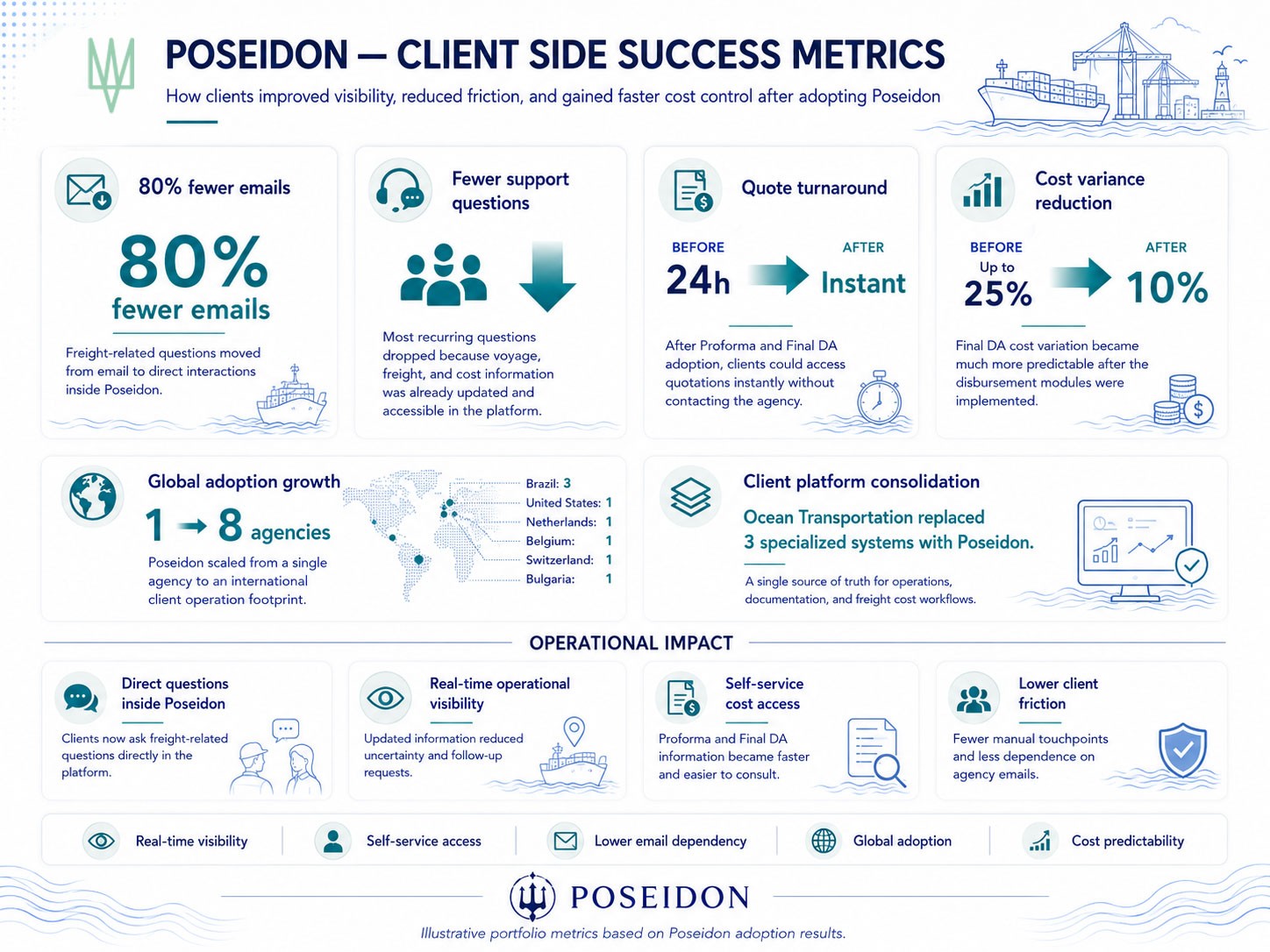
To measure the success of Poseidon, I structured the product metrics around the main value drivers of the platform: operational efficiency, documentation accuracy, disbursement control, user adoption, and stakeholder visibility.
The primary success metric was the number of voyages successfully managed end-to-end in Poseidon, from appointment creation and operational updates to documentation management and Final DA closure. This metric helped evaluate whether the platform was becoming the central workspace for maritime agency operations.
Operational efficiency was measured through indicators such as time to complete the State of Facts, number of overdue tasks per voyage, time to generate production reports, and reduction in manual status updates. Documentation success was tracked by measuring document completion rate per voyage, time to find documents, missing document rates, and document-related errors.
For disbursement workflows, key metrics included time to create a Proforma DA, time to close a Final DA, variance between estimated and final costs, number of cost discrepancies, and approval time. These indicators were essential to evaluate financial accuracy, transparency, and process efficiency.
Because Poseidon was designed as a multi-tenant SaaS platform, adoption metrics were also critical. Active agencies, active users per agency, feature adoption by module, voyages created, Proformas generated, and Final DAs closed helped measure whether the platform was scaling across different teams and operational contexts.
Together, these metrics created a clear framework to evaluate Poseidon not only as an interface, but as a platform capable of reducing manual work, improving operational consistency, increasing financial control, and strengthening visibility across the maritime service ecosystem.